If you manage a warehouse, you already know how easy it is to overlook the condition of your shelving. It sits there day after day, holding thousands of dollars’ worth of inventory, and most people do not give it a second thought until something goes wrong. The problem is, by the time something does go wrong, it is often too late.
Damaged or worn-out shelving is one of the leading causes of warehouse injuries and stock losses. According to OSHA, thousands of workers are injured every year due to collapsed racking systems and overloaded shelves. The good news is that the warning signs are almost always there before a real incident happens. You just need to know what to look for.
This guide walks you through the most common signs that your warehouse shelving has had its day, and it is time to invest in a replacement.
Why Warehouse Shelving Deteriorates Over Time
Even the best quality shelving systems have a shelf life, no pun intended. Constant loading and unloading, forklift impacts, temperature changes, moisture, and simple wear and tear all take a toll. What looked brand new five years ago can become a liability if it has not been properly inspected and maintained.
The issue is not always dramatic. A bent upright here, a cracked beam there. These small problems compound over time, and a shelving unit that looks mostly fine from a distance can be structurally compromised in ways that are not immediately obvious.
Many warehouse operators do not realize that regular racking inspections are not just good practice but a legal requirement in many regions. OSHA and HSE guidelines both require that storage systems be inspected at regular intervals and that any damaged components be taken out of service. You can learn more about warehouse racking safety standards from OSHA to understand your compliance obligations.
10 Clear Signs Your Warehouse Shelving Needs Replacing
1. Visible Bending or Bowing on Uprights and Beams
This is the most obvious sign and also one of the most dangerous. If you can see that a vertical upright is leaning, bowing, or bent at any point, that component needs to come out of service immediately. A bent upright can reduce the load capacity of an entire bay by more than 50 percent, which means shelving that was rated for a certain weight is now severely compromised.
Do not attempt to straighten a bent upright and put it back in use. Once the metal has been deformed under load, its structural integrity is permanently damaged, even if it looks okay after straightening.
2. Rust and Corrosion That Has Gone Deep
Surface rust on shelving is common, especially in warehouses that deal with temperature fluctuations or humidity. A little surface rust can often be treated and is not necessarily a reason to replace a unit. However, when rust has eaten into the metal, and you can see pitting, flaking, or the metal feels soft and crumbles when you press it, that shelving is no longer safe.
Pay particular attention to the base plates and floor anchors. These are the points where the most stress is concentrated, and corrosion here can cause an entire bay to topple with very little warning.
3. Welds That Have Cracked or Come Apart
Run your hand along the welded joints on your shelving. If you feel any roughness, gaps, or visible cracks in the welds, that is a serious structural warning sign. Welded joints are the points where load transfers between components, and a cracked weld under weight can fail catastrophically.
This is particularly common on older shelving that has been loaded and unloaded repeatedly over many years. The metal fatigues at the stress points, and eventually the weld gives way.
4. Missing or Damaged Safety Clips and Locking Pins
Modern pallet racking systems use safety clips and locking pins to keep beams locked into place within the upright frames. These small components play a huge role in keeping the system stable. If clips are missing, broken, or have been removed and not replaced, beams can dislodge under load, especially if there is any lateral pressure from a forklift or heavy item being shifted.
Walk your racking system regularly and check every beam end. If you find missing clips, replace them immediately. If you are finding multiple missing clips across a system, it is a sign that the shelving has seen significant impact over time, and a full inspection is warranted.
5. Floor Anchor Points Are Loose or Missing
Shelving that is not properly anchored to the floor is a serious hazard. Over time, anchor bolts can loosen due to vibration, floor movement, or forklift impacts nearby. Check your base plates regularly. If an anchor bolt is loose, the shelving can shift or topple if impacted.
If you find that anchor holes in the floor have become enlarged or damaged to the point where a bolt no longer holds securely, that section of shelving needs to come out of service until it can be properly refixed or replaced.
6. The System Has Been Hit by a Forklift Multiple Times
Forklift impacts are the number one cause of racking damage in busy warehouses. Even what looks like a minor bump can transfer significant force into the shelving structure. The issue is that damage from forklift impacts is not always visible on the surface. Internal stress fractures and microcracks can form that are only visible through professional inspection.
If your shelving has taken multiple forklift hits over the years, it is worth having a professional assessment done before continuing to load it. The Storage Equipment Manufacturers Association (SEMA) guides post-impact inspection requirements that are worth reviewing.
7. Shelving Is Overloaded or Has Been for Long Periods
Every shelving system comes with a rated load capacity per bay and per shelf level. When shelving is regularly loaded beyond this capacity, even briefly, the metal experiences stress that permanently weakens the structure. Signs of overloading include beams that visibly sag in the middle, unusual creaking or popping sounds when weight is added, and difficulty getting beams to sit level.
If you cannot find the original load rating documentation for your shelving, that alone is a reason to have it professionally assessed. Running shelving without knowing its capacity is a risk that no warehouse should take.
8. The System Is More Than 15 to 20 Years Old
Even well-maintained shelving does not last forever. Most manufacturers design racking systems with a working lifespan in mind, and after 15 to 20 years of use, the cumulative effect of loading cycles, minor impacts, and general wear means the system is approaching the end of its reliable service life.
If your shelving is that old, does not have clear manufacturer documentation, and has been through years of heavy use, a full replacement is often more cost-effective than continually repairing and patching components.
9. Replacement Parts Are No Longer Available
Older shelving systems often use proprietary components that become discontinued as manufacturers update their product lines. If you are finding it difficult or impossible to source replacement beams, clips, or uprights that are compatible with your existing system, that is a practical sign that the system has reached the end of its useful life.
Using non-compatible parts from a different manufacturer is not recommended and can actually void any remaining warranty or certification on the existing system.
10. Your Storage Needs Have Outgrown the System
Sometimes it is not about damage at all. If your warehouse operation has grown significantly, if you are storing heavier pallets, taller loads, or different product types, your existing shelving may not be fit for purpose anymore. Using shelving outside its intended application, whether that is exceeding height limits, storing items with unusual weight distribution, or stacking in ways the system was not designed for, is just as dangerous as using physically damaged shelving.
Signs Your Warehouse Shelving Needs Replacing
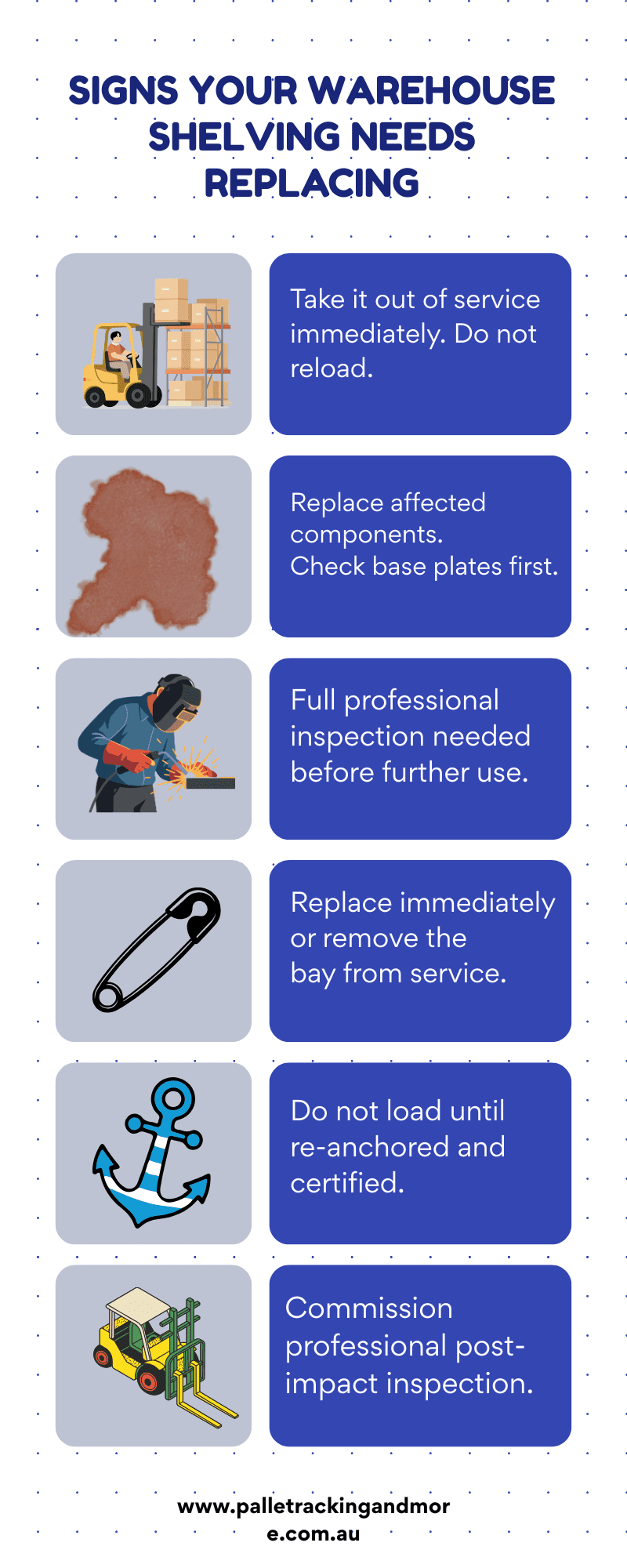
What to Do When You Spot the Warning Signs
The moment you identify any of these warning signs, the priority is to stop using the affected area. Remove stock, cordon off the bay, and make sure no one loads it until it has been professionally assessed. This is not overcaution. It is standard practice, and it is the kind of thing that gets documented in incident reports after the fact when people skip it.
Contact your shelving supplier or a qualified racking inspector to carry out a formal assessment. A good inspector will give you a detailed report on which components need replacing, which bays can continue in service with repairs, and where full replacement is the safer option.
It is also worth reviewing your inspection schedule going forward. The Rack Manufacturers Institute recommends annual inspections as a minimum, with more frequent walkthroughs in high traffic areas or where forklift activity is regular.
Replacement vs Repair: Making the Right Call
Not every damaged component means you need to replace the entire shelving system. In many cases, individual beams, uprights, or clips can be swapped out, and the system can continue in safe use. The key is to use genuine replacement parts from the original manufacturer or a certified compatible supplier.
However, replacement is usually the better option when the damage is widespread across multiple bays, when the system is old, and parts are hard to source, when the cumulative cost of repairs is approaching the cost of new shelving, or when the system no longer meets your current storage requirements.
New shelving systems today are significantly better engineered than systems from 15 or 20 years ago. Modern racking offers better load ratings, improved corrosion resistance, easier adjustment and reconfiguration, and clearer load notice systems. The upfront cost is real, but the reduction in risk and the improvement in operational efficiency often justify it quickly.
Building a Regular Inspection Routine
The best way to stay ahead of shelving problems is to build regular inspection into your warehouse operations. This does not have to be complicated. A simple visual walkthrough once a week takes very little time and can catch problems before they become serious.
Train your team to know what to look for. Give them a simple checklist they can run through when they are in the racking aisles. Encourage a culture where anyone who spots a problem feels comfortable reporting it without delay.
Formal professional inspections should happen at least once a year, or after any significant incident such as a forklift collision or a near miss. Keep records of all inspections, repairs, and replacements. This documentation protects your business in the event of an incident and helps you track the overall condition of your shelving over time.
Final Thoughts
Warehouse shelving is one of those things that tends to be out of sight and out of mind until there is a problem. The reality is that the warning signs are almost always there if you know what to look for. Bent uprights, missing clips, deep rust, loose anchors, and overloaded bays do not just appear overnight. They develop gradually, and a consistent inspection routine is all it takes to catch them before they become a serious incident.
The cost of replacing damaged shelving is a fraction of the cost of a workplace injury, a stock loss from a collapse, or the legal and reputational consequences of a safety violation. Treat your shelving as the critical infrastructure it is, and make inspections a non-negotiable part of your warehouse management routine.
Is Your Warehouse Shelving Showing Any of These Signs?
If anything in this article looked familiar, do not put it off. Damaged or ageing shelving is a safety risk that only gets worse over time.
At Pallet Racking and More, we supply and install AS 4084-compliant racking systems for warehouses across Australia. Free quotes, expert advice, and same-day stock availability from our Sydney warehouse.
Frequently Asked Questions
How often should warehouse shelving be inspected?
At a minimum, a formal professional inspection should happen once a year. In busier warehouses or facilities with regular forklift traffic, quarterly inspections are a better standard. In addition to formal inspections, someone on your team should be doing a basic visual walkthrough at least once a week.
Is it safe to use shelving after it has been hit by a forklift?
Not without an inspection first. Even what appears to be a minor impact can cause internal structural damage that is not visible to the naked eye. The safest approach is to take the affected bay out of service immediately after any forklift impact and have it assessed by a qualified inspector before reloading it.
Can I repair damaged shelving myself?
Basic maintenance, like replacing missing safety clips or tightening loose anchor bolts, can be handled in-house, provided you are using genuine compatible parts. Structural repairs to bent uprights, cracked welds, or damaged base plates should always be handled by a qualified professional. Attempting structural repairs without the right expertise can make the problem worse and create additional liability.
How do I know what load capacity my shelving is rated for?
Load ratings should be displayed on a load notice placard attached to each bay. If your shelving does not have these, contact the original manufacturer with the product details or serial number. If you cannot identify the manufacturer, a qualified racking inspector can assess the system and provide estimated capacity guidance, though operating without official documentation is not ideal.