Last Updated: 26 December 2025
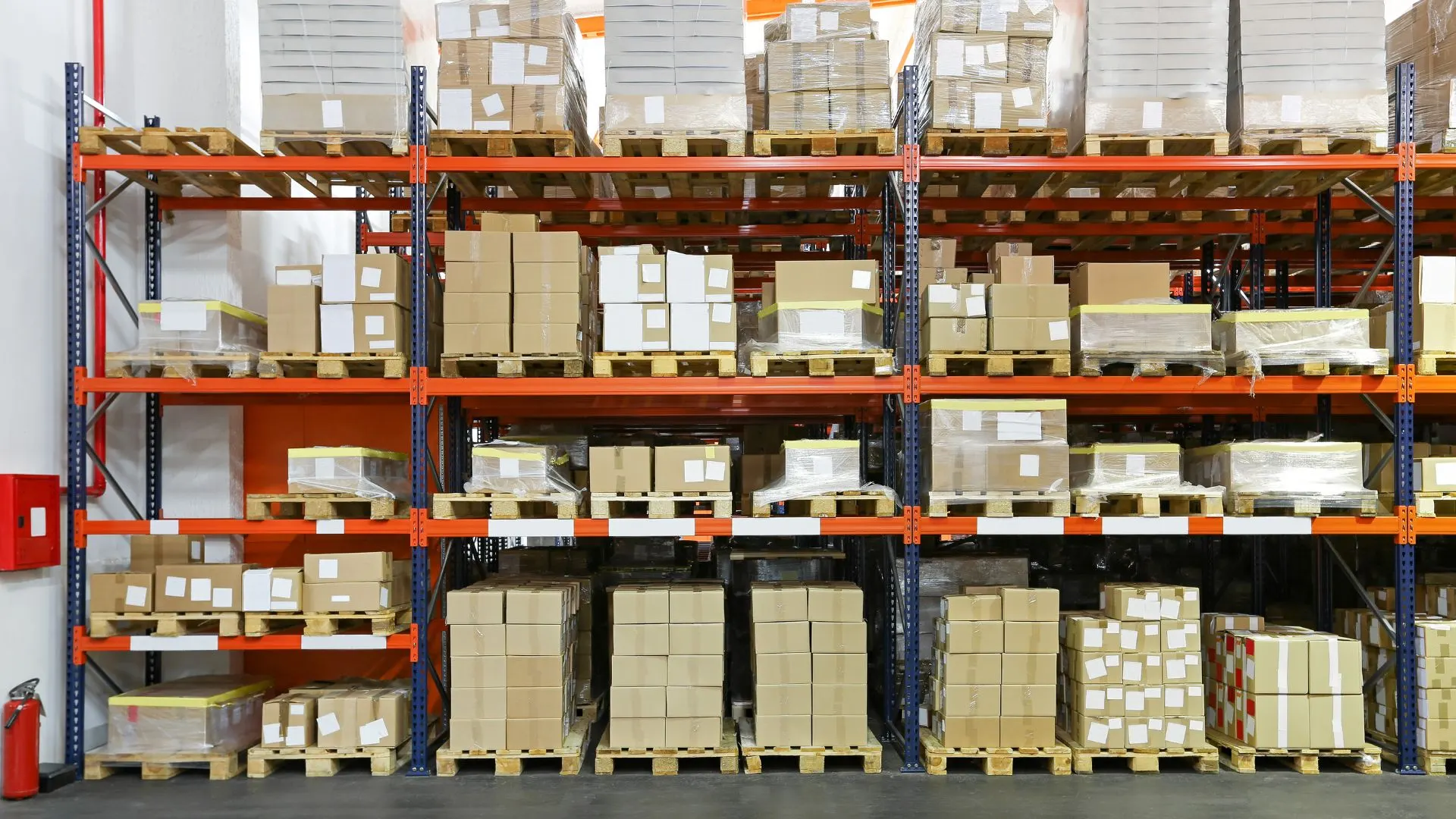
In warehouses where efficiency and product accessibility matter, selective pallet racking stands as the most widely adopted storage solution across Australia. This system provides direct access to every stored pallet, making it the preferred choice for facilities managing diverse inventory with varying turnover rates.
According to Standards Australia’s AS 4084:2021, selective pallet racking accounts for approximately 80% of warehouse racking installations nationwide due to its flexibility, straightforward operation, and compatibility with standard material handling equipment. This guide synthesizes information from Australian safety standards, industry data, and professional installation practices to help warehouse managers evaluate whether selective racking suits their operational requirements.
What Is Selective Pallet Racking?
Selective pallet racking consists of vertical upright frames connected by horizontal load beams, creating individual storage bays accessible from the aisle. Unlike high-density systems, where pallets are stored multiple positions deep, selective racking arranges pallets in single-depth rows, allowing forklifts to retrieve any pallet without moving others.
Key Structural Components
Upright frames: Vertical columns constructed from roll-formed or structural steel, typically 80-100mm deep for standard-duty applications. According to AS 4084:2021 specifications, frames must be engineered to support combined vertical and horizontal loads.
Load beams: Horizontal members that connect uprights and support pallet loads. Beams attach to uprights using safety clips or locking pins, with adjustment possible at 50-75mm vertical increments to accommodate different pallet or product heights.
Bracing and anchoring: Diagonal bracing provides lateral stability, while base plates anchor the system to warehouse floors meeting minimum 150mm concrete thickness requirements specified by Australian standards.
Safety components: Beam safety clips prevent accidental dislodgement, while load capacity signage (mandatory under AS 4084:2021) displays maximum safe working loads at each bay.
Key Benefits of Selective Pallet Racking Systems
1. Complete Pallet Selectivity and Access Speed
Every pallet position remains directly accessible without moving adjacent stock. Research from the Material Handling Industry of America indicates this configuration improves picking efficiency by 20-35% compared to block stacking or lane-based storage, particularly in facilities with high SKU counts or frequent inventory rotation.
2. Flexible Configuration and Easy Adjustment
Beam levels adjust vertically without requiring system disassembly, accommodating seasonal inventory changes or new product lines. This adaptability makes selective racking suitable for businesses with evolving storage needs. Australian warehouse operators report that beam adjustment typically takes 10-15 minutes per bay using basic hand tools, allowing same-day reconfiguration.
3. Cost-Effective Implementation
Selective pallet racking represents the most economical racking investment for most applications. Based on December 2024 Australian market data, installed costs typically range from $80-$150 per pallet position, compared to $200-$350 for drive-in systems or $250-$400 for push-back racking. The system works with standard counterbalance forklifts, eliminating specialized equipment requirements.
4. Simplified Inventory Management
The direct-access design supports First-In-First-Out (FIFO) inventory rotation essential for perishable goods, date-sensitive products, or quality-controlled manufacturing inputs. According to Safe Work Australia’s warehouse management guidance, this visibility also simplifies stock counting, cycle counting, and inventory accuracy verification.
Technical Specifications and Capacity
Understanding selective racking specifications helps warehouse managers match systems to operational requirements:
| Specification | Typical Range | Notes |
|---|---|---|
| Load capacity per level | 1,000-3,000 kg | Varies by beam profile and span |
| Bay width | 2,700-3,600 mm | Accommodates 2-3 pallets per level |
| Beam length | 1,800-3,600 mm | Depends on pallet quantity per bay |
| Upright height | 3,000-12,000 mm | Limited by building height and forklift reach |
| Aisle width | 3,000-3,600 mm | For standard counterbalance forklifts |
| Beam adjustment | 50-75 mm increments | Allows precise height customization |
These specifications align with AS 4084:2021 design requirements and typical Australian pallet dimensions (1,165mm x 1,165mm standard, 1,200mm x 1,000mm Euro pallet).
Applications and Industry Suitability
Selective pallet racking serves diverse industries across Australia:
Retail and e-commerce distribution: Fast-moving consumer goods requiring frequent access and varied SKUs. The system’s selectivity supports order picking operations and supports high transaction volumes.
Food and beverage logistics: Perishable inventory requiring strict FIFO rotation and regular stock turnover. Direct pallet access ensures older stock moves before newer deliveries.
Manufacturing and industrial supply: Component storage, raw materials, and finished goods with varied dimensions. Adjustable beam heights accommodate changing production requirements.
Third-party logistics (3PL): Multi-client facilities that store diverse products with varying handling frequencies. Selective racking’s flexibility suits dynamic inventory mixes.
Automotive parts distribution: Fast-moving and slow-moving items stored together, requiring selective access to specific SKUs without disrupting adjacent inventory.
According to industry surveys, facilities with more than 50 SKUs and inventory turnover exceeding 4-6 times annually typically benefit most from selective racking configurations.
Storage Density Considerations and Limitations
While selective pallet racking offers maximum accessibility, it provides lower storage density compared to high-density alternatives. Understanding these trade-offs helps managers make informed decisions:
Space Utilization Comparison
Selective racking: Typically achieves 40-50% floor space utilization due to aisle requirements. Each bay stores pallets single-deep, with 3-3.5 meter aisles occupying approximately 50-60% of total floor area.
Drive-in/drive-through: Achieves 70-85% floor space utilization by eliminating intermediate aisles. However, last-in-first-out (LIFO) inventory flow limits suitability for many applications.
Push-back racking: Provides 60-70% space utilization with semi-selective access. Pallets store 2-5 deep but require consistent product per lane.
When Selective Racking Is Most Appropriate
According to warehouse design research, selective racking provides optimal value when:
- SKU count exceeds 50 items requiring individual access
- Inventory turnover rates vary significantly between products
- FIFO rotation is operationally critical
- Order picking represents the primary warehouse activity
- The available ceiling height is limited (under 8 meters)
- The forklift fleet consists of standard counterbalance equipment
For facilities with limited floor space, homogeneous products, and low SKU counts, higher-density systems may deliver better space utilization despite reduced accessibility.
Australian Compliance and Safety Standards
All selective pallet racking installations in Australia must comply with AS 4084:2021, which governs design, installation, inspection, and maintenance.
Mandatory Requirements
According to AS 4084:2021, warehouse operators must ensure:
Engineering certification: Every installation requires signed structural calculations from a qualified engineer registered in Australia, certifying that the system meets load capacity requirements and safety factors.
Load capacity signage: Visible load capacity plates must be installed at each rack bay, clearly stating maximum beam load, bay load, and any special loading restrictions. Signs must remain legible throughout the system’s service life.
Annual inspections: Professional inspections by a “competent person” (someone with adequate training and experience in racking systems) must occur at least annually, with findings documented and retained for a minimum of seven years.
Proper installation: Systems must be installed according to manufacturer specifications and engineering drawings, including correct floor anchoring using appropriate chemical or mechanical anchors.
WorkSafe Victoria and equivalent state regulatory bodies enforce these requirements through workplace inspections, with non-compliance resulting in improvement notices, prohibition orders, or prosecutions depending on violation severity.
Ongoing Safety Management
Beyond initial compliance, effective safety management includes:
Monthly visual inspections: Internal checks by trained warehouse staff identify damage between professional inspections. Common issues include upright dents from forklift impacts, beam deflection indicating overloading, missing safety clips, or movement of the floor anchor.
Immediate damage response: AS 4084:2021 uses a traffic-light classification system. Red-level damage (severe structural compromise) requires immediate bay unloading and isolation. Amber-level damage (significant issues) needs load reduction and repair within 2-4 weeks. Green-level damage (minor cosmetic issues) can be addressed during scheduled maintenance.
Staff training: According to Safe Work Australia guidance, all forklift operators and warehouse staff should receive instruction on load limits, proper pallet placement, damage recognition, and reporting procedures.
Professional inspection services in Australia typically cost $500-$1,500 annually, depending on facility size, while comprehensive safety assessments range from $2,000-$8,000.
Installation Costs and ROI Considerations
Understanding complete project costs helps warehouse managers budget appropriately and evaluate return on investment.
Typical Investment Breakdown (December 2024 Australian Market)
Materials and installation:
- Light-duty selective racking (1,000-1,500 kg per level): $80-$120 per pallet position
- Medium-duty systems (1,500-2,500 kg per level): $120-$150 per pallet position
- Heavy-duty configurations (2,500-3,000 kg per level): $150-$200 per pallet position
These figures include upright frames, beams, safety components, installation labor, and basic engineering certification.
Additional project costs:
- Floor assessment and repairs (if required): $2,000-$8,000
- Column protection guards: $150-$400 per upright
- Annual professional inspections: $500-$1,500
- Engineering certification (complex layouts): $2,000-$5,000
Return on Investment Factors
Industry analysis suggests selective pallet racking systems typically achieve payback within 18-36 months through:
Space optimization: Converting floor-stacked inventory to racking typically increases storage capacity by 60-100%, potentially deferring or eliminating warehouse expansion costs.
Labor efficiency: Direct pallet access reduces picking time by 20-35% compared to block stacking, lowering labor costs per order.
Inventory accuracy: Improved organization and visibility reduce stock discrepancies and associated costs.
Product protection: Proper storage reduces damage from stacking pressure, forklift handling, or environmental exposure.
Safety and Maintenance Best Practices
Selective pallet racking requires ongoing attention to maintain structural integrity and operational safety.
Critical Safety Practices
Respect load capacity limits: Never exceed engineered load ratings displayed on capacity plates. Even modest overloading (10-15% above rated capacity) can compromise structural safety margins.
Install impact protection: Column guards at upright bases absorb forklift impacts, preventing structural damage. Research indicates that protected installations experience 60-80% fewer upright replacements than unprotected systems.
Maintain clear aisles: Keep aisles free from obstructions and ensure adequate clearance for forklift operations. Standard counterbalance forklifts require a minimum of 3-meter aisles for safe maneuvering.
Document all incidents: Record every forklift impact, load capacity question, or observed damage. Documentation demonstrates due diligence during regulatory audits and helps identify recurring problems requiring systematic solutions.
Conduct regular inspections: Weekly visual checks by warehouse staff, monthly internal inspections using standardized checklists, and annual professional assessments by qualified inspectors create layered safety oversight.
Common Damage Types and Response
According to AS 4084:2021 guidance, common selective racking damage includes:
- Upright deformation from forklift contact
- Beam deflection from overloading
- Missing or damaged safety clips
- Loose floor anchors
- Corrosion (particularly in coastal or high-moisture environments)
Any structural damage requires assessment by qualified personnel before continued use. Temporary repairs or deferred maintenance violate safety standards and create significant liability exposure.
Implementation Planning Checklist
Based on professional installation practices and AS 4084:2021 requirements, successful selective racking implementation includes:
Initial Assessment:
- Document all inventory dimensions, weights, and pallet specifications
- Calculate required storage positions (current needs plus 20-30% growth)
- Measure warehouse dimensions, ceiling height, and floor conditions
- Identify forklift specifications and operational requirements
- Review AS 4084:2021 compliance requirements
Design and Procurement:
- Engage qualified suppliers with AS 4084:2021 certification
- Obtain a minimum of three competitive quotes
- Review engineering calculations and load capacity ratings
- Verify compliance with Australian standards
- Confirm warranty terms and inspection services
Installation and Commissioning:
- Complete any required floor repairs before installation
- Verify installer qualifications and insurance
- Ensure proper component assembly and anchoring
- Install load capacity signage at all bays
- Obtain final engineering certification
- Conduct staff training on safe operation
Ongoing Operations:
- Establish weekly visual inspection procedures
- Schedule monthly internal safety reviews
- Arrange annual professional inspections
- Maintain documentation for a minimum of 7 years
- Budget for ongoing maintenance and repairs
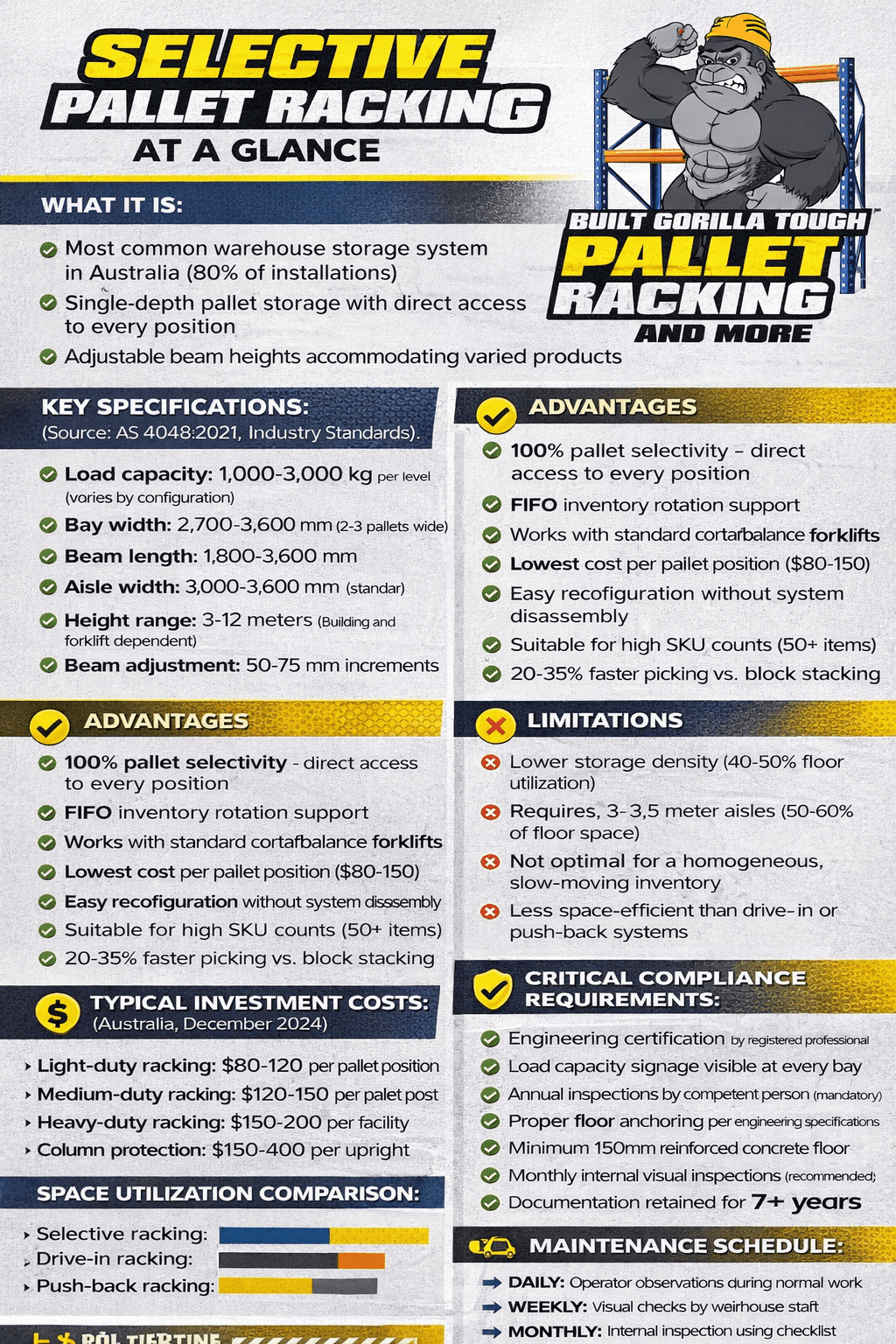
SELECTIVE PALLET RACKING AT A GLANCE
Conclusion
Selective pallet racking delivers the optimal balance of accessibility, flexibility, and cost-effectiveness for most Australian warehouse operations. While storage density is lower than high-density alternatives, the system’s complete pallet selectivity, straightforward operation, and broad applicability across industries explain its position as Australia’s most widely adopted racking configuration.
Successful implementation requires understanding AS 4084:2021 compliance obligations, proper system specification matching operational requirements, professional installation by qualified providers, and ongoing maintenance ensuring long-term structural integrity. Facilities investing in appropriate selective racking systems with proper engineering, installation, and safety management create efficient, compliant storage infrastructure supporting business growth and operational excellence. PalleTracking & More provides end-to-end racking solutions from design and consultation to installation, audits, and maintenance.
Information in this guide is derived from Australian Standards, Safe Work Australia resources, and recognised industry guidance. Final system design, load capacities, and compliance obligations must be verified by qualified professionals for each site.
Read More Articles
Shelving Solutions for Homes, Offices, and Warehouses
Drive In Pallet Racking Guide For High Density Storage
Frequently Asked Questions
Q: What is selective pallet racking, and how does it differ from other warehouse storage systems?
Selective pallet racking is a single-depth storage system providing direct access to every pallet position from the aisle. According to Standards Australia’s AS 4084:2021, it represents approximately 80% of warehouse racking installations in Australia due to its versatility and accessibility. Unlike drive-in systems, where pallets store multiple positions deep (2-10 pallets), or push-back racks using gravity-fed lanes, selective racking arranges pallets in single rows accessible without moving adjacent stock.
Q: What are the costs associated with selective pallet racking installation in Australia?
Based on December 2024 Australian market data, selective pallet racking costs $80-$200 per installed pallet position, depending on load capacity requirements. Light-duty systems (1,000-1,500 kg per level) range from $80-$120 per position, medium-duty (1,500-2,500 kg) cost $120-$150, while heavy-duty configurations (2,500-3,000 kg) run $150-$200 per position.
Q: What are the Australian safety and compliance requirements for selective pallet racking?
All selective pallet racking in Australia must comply with AS 4084:2021, the Australian Standard for Steel Storage Racking. According to Standards Australia, mandatory requirements include engineering certification by a qualified, registered professional showing the system meets design loads and safety factors; load capacity signage installed at every bay displaying maximum safe working loads; and annual inspections by a “competent person” with findings documented and retained for a minimum of seven years.
Q: Is selective pallet racking suitable for small warehouses with limited space?
Selective pallet racking’s suitability for small warehouses depends on operational priorities. According to warehouse design research from the Material Handling Industry, selective racking achieves 40-50% floor space utilization because aisles occupy approximately 50-60% of total area. For facilities prioritizing accessibility, varied inventory, FIFO rotation, or high SKU counts (50+ items), selective racking remains appropriate regardless of warehouse size.