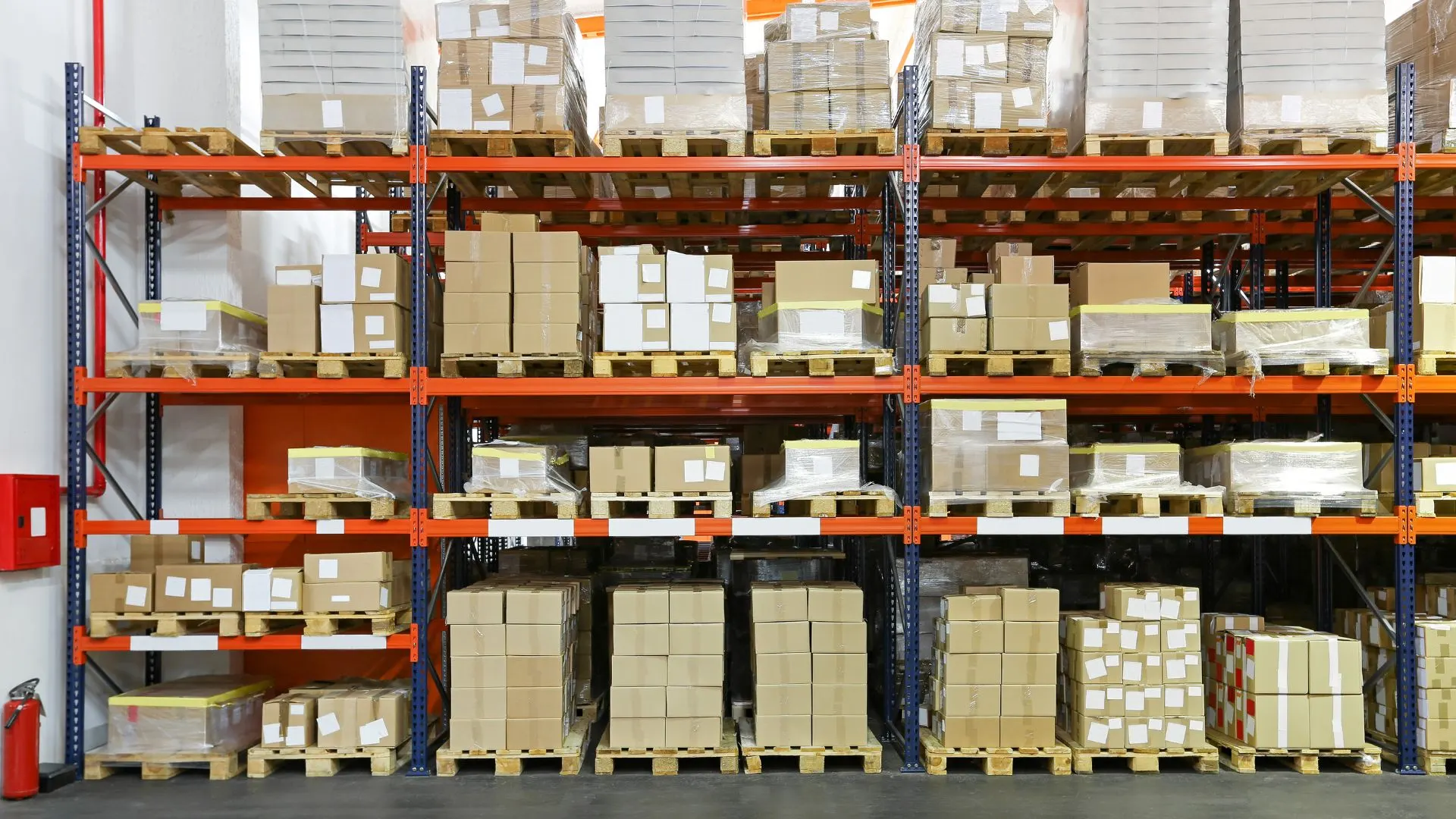
Efficient management of a warehouse is essential for businesses of all sizes. Double deep pallet racking is a modern storage system that allows warehouses to store more inventory without increasing the floor space.
This system differs from the traditional single deep racking method, in which pallets are stored only one per bay. Businesses that implement double deep warehouse racking achieve improved space efficiency, enhanced safety for staff and products, and greater control over operational processes.
When designing a warehouse layout, understanding the structure and advantages of double deep pallet racking helps businesses save space, reduce costs, and improve overall workflow efficiency. It is essential to consider the type of inventory, the turnover rate, and the available equipment when choosing the right system.
What is a Double Deep Pallet Racking System?
A double deep pallet racking system consists of racks that store two pallets per bay, with one positioned behind the other. By reducing the number of aisles, warehouses free up extra floor space that can be used for additional inventory, equipment placement, or safe movement of employees.
Key Features Of Double Deep Pallet Racking
- Stores two pallets per bay instead of one, greatly increasing storage density.
- Reduces aisle space, allowing more pallets to be stored within the same area.
- Requires reach trucks or telescopic forklifts to safely access the second pallet.
- Supports heavy loads and accommodates different pallet sizes, making it suitable for many industries.
- Improves organisation and inventory management by grouping similar products.
Warehouses using this system report faster inventory handling and more efficient utilisation of storage space. It is particularly suited for products with moderate turnover that do not require frequent access to every pallet.
Advantages Of Double Deep Warehouse Racking
Using double deep selective racking provides many benefits for warehouses of all sizes, balancing high storage density with operational efficiency.
1. Maximise Storage Capacity
Placing pallets two deep allows warehouses to increase storage capacity without adding extra building space. Areas that previously required additional aisles now store the same volume of inventory more efficiently within the existing footprint.
2. Cost Efficiency
Double deep racking reduces the number of aisles, lowering construction and operational costs. Less floor space dedicated to pathways allows warehouses to accommodate more inventory or equipment without physical expansion.
3. Improved Workflow
With fewer aisles, forklifts move more efficiently, and staff spend less time walking or driving between storage points. This improves productivity and reduces labour costs.
4. Safety And Stability
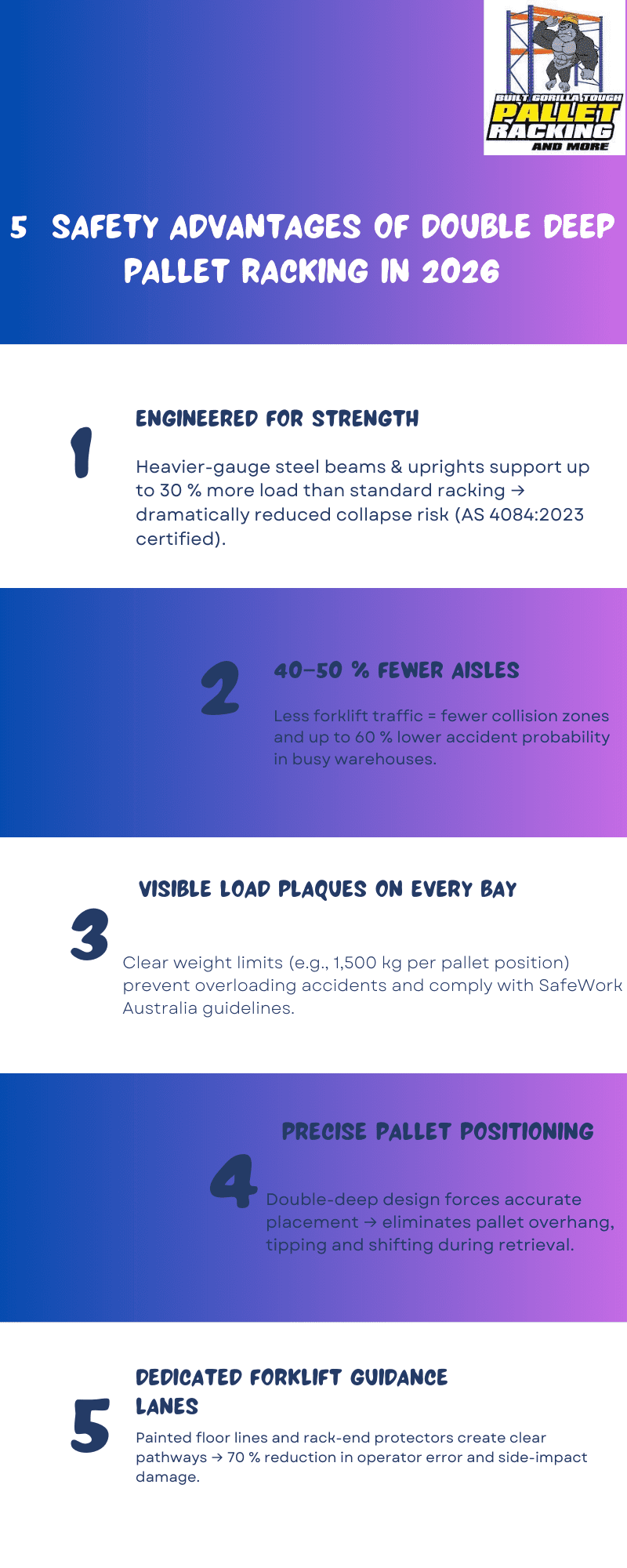
Racks are built from strong steel designed to hold heavy pallets securely. Correct installation and regular inspections prevent accidents caused by pallet shifts, overloading, or structural failure.
5. Scalability
Double deep racks are modular, and additional bays or levels may be added as inventory grows. Expansion does not require significant changes to the existing warehouse layout.
6. Environmental Efficiency
Optimised warehouse layouts with double deep racking reduce unnecessary forklift travel, which saves electricity or fuel. Reduced energy consumption lowers operational costs and improves sustainability in warehouse operations.
These advantages explain why many modern warehouses prefer double deep racking over traditional single deep systems.
Types Of Double Deep Pallet Racking
Choosing the right type of double deep racking is important for optimising warehouse storage.
1. Double Deep Selective Racking
This is the most common double-deep system. It provides easy access to the first row of pallets, while the second row requires a reach forklift. It is ideal for warehouses that store mixed inventory with moderate turnover.
2. Double Deep Drive-In Racking
This system is designed for high-density storage of large volumes of identical items. Pallets are loaded from one side using a first-in, last-out method. Reduced aisle space allows maximum storage, making it suitable for bulk inventory.
3. Double Deep Push-Back Racking
Push-back racks use carts along rails. When a new pallet is loaded, the previous pallet moves backwards along the rails. This system provides high-density storage while allowing easier access than drive-in racking.
4. Double Deep Pallet Flow Racking
Pallet flow racks use rollers to move pallets along gravity-fed tracks. This follows a first-in, first-out inventory method, ensuring proper stock rotation and reducing manual handling.
Selecting the correct type of racking ensures operational efficiency and cost-effectiveness.
5 Safety Advantages of Double Deep Pallet Racking in 2026
Double Deep Pallet Racking Dimensions
Correct double deep pallet racking dimensions are essential for safety, efficiency, and warehouse layout optimisation.
Standard Specifications
- Depth: Approximately 2.4 meters per double row.
- Height: Racks range from 3 meters to over 12 meters, depending on ceiling height and storage requirements.
- Bay Width: Typically 2.7–3 meters to allow forklift access.
- Load Capacity: Supports up to 2,500 kilograms per pallet.
- Aisle Width: Reduced compared to single deep racking to optimise available space.
Planning Tips
- Ensure sufficient vertical clearance for forklifts and pallet loads.
- Match pallet size and weight with rack specifications to avoid overloading.
- Consider future expansion when determining rack height and depth.
- Plan aisle layout and workflow to allow safe and efficient forklift movement.
Proper planning prevents accidents, reduces damage, and improves warehouse efficiency.
Double Deep Racking Vs Single Deep Racking
A comparison of double deep racking vs single deep racking helps businesses choose the best system.
|
Feature |
Single Deep Racking |
Double Deep Racking |
|
Pallets Per Bay |
1 | 2 |
| Storage Density | Standard |
High |
|
Aisle Requirement |
More | Less |
|
Forklift Type |
Standard |
Reach or Telescopic |
| Ideal Use | High turnover |
Bulk storage, moderate turnover |
Installation And Planning Guide
Proper installation ensures the double deep warehouse racking system remains safe, efficient, and long-lasting.
Step 1: Assess Warehouse Requirements
Measure floor space, ceiling height, aisle width, and inventory type. Evaluate pallet weight and turnover to design an optimal layout.
Step 2: Select The Right System
Choose between selective, push-back, drive-in, or flow racking according to storage and operational requirements.
Step 3: Choose Suitable Forklifts
Reach trucks or telescopic forklifts are required for accessing the second row safely. Staff must be trained in correct handling methods to reduce the risk of accidents.
Step 4: Install Racks Safely
Use certified installers. Ensure racks are level, securely anchored, and have enough clearance. Clearly mark load limits for staff.
Step 5: Conduct Safety Inspections
Regularly inspect racks for wear, damage, or misalignment. Tighten bolts and check load limits to maintain safety standards.
Following these steps prevents accidents, extends the lifespan of the racks, and improves operational efficiency.
Operational Efficiency And ROI
Investing in double deep pallet racking improves warehouse efficiency and provides a significant return on investment.
Benefits
- Increases storage capacity without requiring warehouse expansion.
- Reduces aisle space, allowing more room for operations.
- Streamlines workflow, lowering labour and handling time.
- Minimises forklift travel, saving fuel or electricity.
Cost Considerations
Initial investment includes racks, forklifts, and installation. Long-term savings arise from higher storage density, lower operational costs, and improved inventory management. Many warehouses recover the initial costs within a few months.
Best Practices For Double Deep Pallet Racking
To achieve maximum benefits:
- Maintain accurate records of all pallet locations.
- Use inventory management software for efficient stock control.
- Train staff in safe forklift operation and pallet handling.
- Conduct regular inspections and maintenance of racks.
- Plan modular expansions to accommodate future growth.
Conclusion
Double deep pallet racking provides an efficient solution for warehouses that aim to increase storage capacity, improve operational workflow, and reduce overall costs. By understanding the types of racking, proper dimensions, forklift requirements, and layout planning, businesses achieve safe, cost-effective, and productive storage solutions. Following best practices, such as staff training, accurate record-keeping, and regular inspections, further ensures the longevity and performance of the racking system.
For businesses seeking high-quality double deep pallet racking systems and professional installation support, visit Pallet Racking and More to explore the range of warehouse storage solutions and receive expert guidance.
FAQs
What Is Double Deep Pallet Racking Used For?
It stores pallets two rows deep, allowing warehouses to maximise storage space while maintaining accessibility.
How Does It Differ From Single Deep Racking?
Double deep racks hold two pallets per bay, saving space, whereas single deep racks allow faster access but require more aisle space.
What Forklifts Are Required For Double Deep Racking?
Reach trucks or telescopic forklifts are needed to access pallets in the second row safely.
Are Double Deep Racks Safe For Heavy Loads?
Yes, with correct installation and regular maintenance, these racks provide safe support for heavy pallets.