Last updated on:
Storing long or awkward materials is one of those challenges that seems manageable until you deal with it daily. Pipes roll, timber bends, and steel sections rarely sit neatly on standard pallet racking. Across Australian warehouses, yards, and trade-focused facilities, this often results in wasted space, slower handling, and unnecessary safety risks.
Cantilever racking is designed to address this specific issue. It is not a general-purpose storage system, but when used for the right materials, it becomes one of the most practical and efficient solutions available.
What Cantilever Racking Is and Why It Is Used
Cantilever racking is an open-front storage system built around vertical columns with horizontal arms extending outward. Unlike pallet racking, there are no front uprights blocking access to the load.
This design exists for a simple reason: long and bulky items do not suit pallet-based storage. Materials such as timber, pipes, steel bars, and aluminium profiles require clear access and even support along their length. Cantilever racking provides this without forcing materials into an unsuitable configuration.
How Cantilever Racking Works
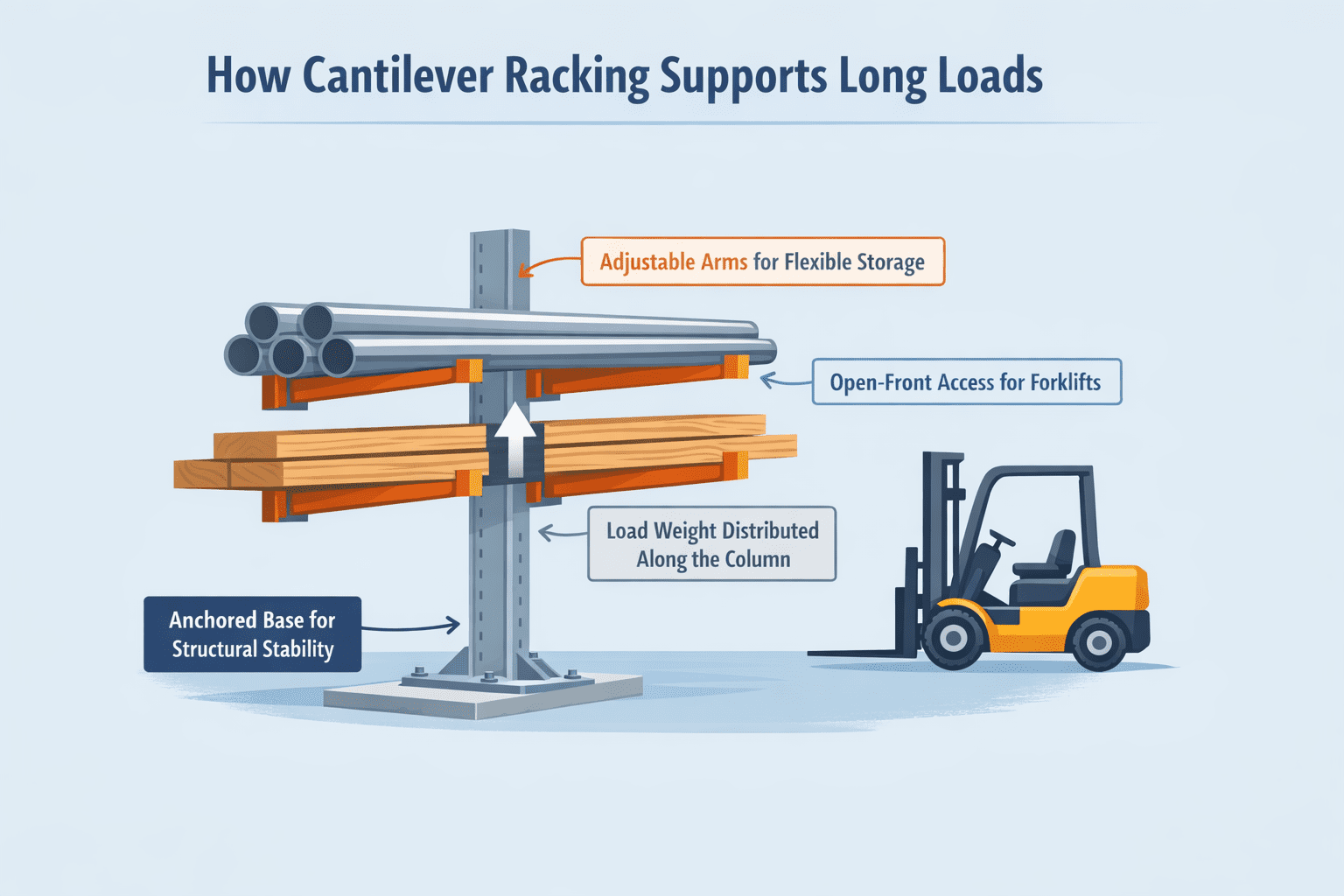
Structurally, cantilever racking transfers weight from the arms into the vertical columns and down to the floor. When installed and anchored correctly, the load is distributed evenly rather than concentrated at a few stress points.
A typical system includes vertical columns anchored to a solid floor, adjustable horizontal arms to accommodate changing material sizes, an open-front layout for direct forklift or manual access, and a stable base designed to handle heavy and irregular loads. This straightforward design is what makes the system reliable in real operating environments.
How Cantilever Racking Supports Long Loads
Where Cantilever Racking Is Commonly Used in Australia
In Australia, cantilever racking is widely used across industries that store long materials, particularly where outdoor or semi-covered storage is common due to space availability.
Typical applications include timber yards and building supply warehouses, steel and aluminium service centres, construction material storage facilities, PVC pipe and conduit suppliers, and fabrication or joinery workshops. Because many Australian sites rely on external storage areas, environmental exposure often plays a key role in system selection.
What Works Well in Practice
Experience across different installations shows that a few factors consistently determine long-term performance.
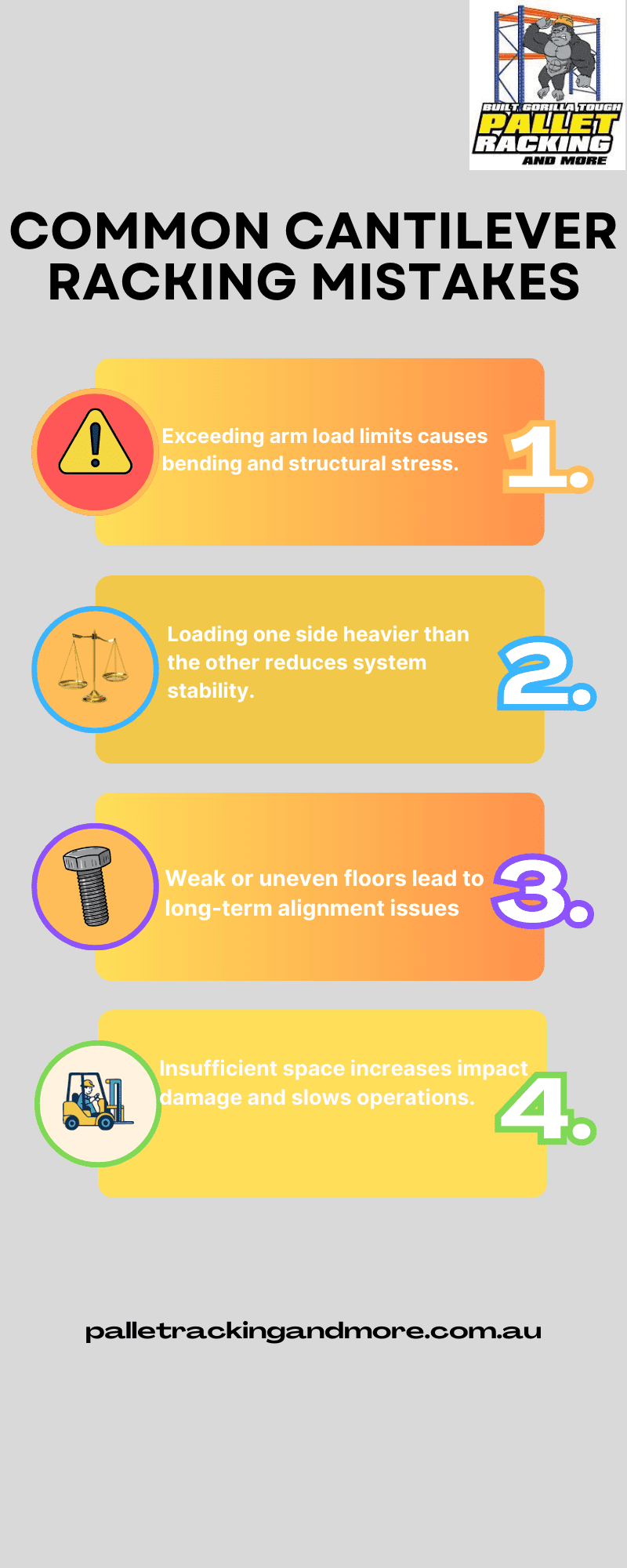
Adjustable arms provide flexibility as material sizes and stock profiles change over time. Fixed arm positions often become limiting within a short period. Correct load ratings are critical, especially for steel and hardwood, which place significant stress on arms and columns. Realistic load calculations prevent bending and premature wear. Clear, straight access improves safety and efficiency, as cantilever racking performs best when forklifts can approach loads directly without tight turning angles.
Common Mistakes to Avoid
Single-Sided vs Double-Sided Cantilever Racking
Single-sided cantilever racking is typically installed against walls and suits narrower areas where space is limited. It offers lower overall storage density but works well in constrained layouts.
Double-sided cantilever racking is used in open floor plans and provides higher storage capacity. It is generally more efficient for higher-volume operations where materials move frequently. The right choice depends on layout, traffic flow, and how materials are handled, rather than on preference.
Indoor vs Outdoor Cantilever Racking
| Feature | Indoor Cantilever Racking | Outdoor Cantilever Racking |
|---|---|---|
| Typical environment | Enclosed warehouses and workshops | External yards and open storage areas |
| Weather exposure | None | Rain, sun, humidity, temperature variation |
| Surface finish | Painted or powder-coated steel | Galvanised or weather-resistant coatings |
| Maintenance level | Lower, mostly visual checks | Higher, with corrosion monitoring |
| Common Australian use | Fabrication and trade workshops | Steel yards, timber yards, construction supply |
In Australia’s climate, outdoor systems are often exposed to high UV levels, coastal moisture, and seasonal temperature changes. For this reason, galvanised finishes and corrosion-resistant coatings are commonly used, particularly in coastal and high-humidity regions.
Ignoring environmental factors does not usually cause immediate issues, but it often shortens the usable life of the system.
Guidance from Safe Work Australia highlights the importance of considering environmental conditions, load management, and installation quality when selecting and maintaining warehouse storage systems
Safety and Maintenance Considerations
Although cantilever racking appears simple, it still requires routine attention. Arms should remain straight and undamaged, anchor bolts must stay secure, load limits should be clearly displayed and followed, and loads must be evenly distributed. Forklift access paths should remain clear at all times.
Repeated forklift contact with racking is not normal wear and typically indicates layout or training issues that should be addressed early.
Is Cantilever Racking Always the Right Solution?
Cantilever racking is purpose-built and is not suitable for every storage requirement. It is generally not ideal for small boxed items, mixed palletised inventory, or high-density vertical pallet storage. In those cases, pallet racking or shelving systems are often more appropriate.
Final Thoughts from Practical Use
Cantilever racking works because it solves a specific storage problem rather than attempting to cover every scenario. In Australian warehouses and yards, it performs best when selected based on actual material types, realistic load assessments, and environmental exposure.
When planned carefully and installed correctly, it becomes a long-term storage solution that improves safety, efficiency, and material handling without unnecessary complexity.
How to Choose the Right Cantilever Racking for Your Site
If you are considering cantilever racking for your facility, the most effective approach is to assess what you are storing, how often it moves, whether storage will be indoors or outdoors, and how forklifts or handling equipment will access the load.
At pallet racking and more, systems are typically selected based on real-world usage rather than generic sizing. Matching arm capacity, column height, and finish to your specific environment helps avoid overspending on unnecessary features while ensuring long-term safety and reliability.
If you are unsure which configuration suits your operation, reviewing your material dimensions, load weights, and available floor space before making a decision will lead to better outcomes and fewer adjustments later.
Frequently Asked Questions
Does cantilever racking need to meet Australian safety requirements?
Yes. While requirements vary by state, storage systems should align with Australian workplace safety guidance, including correct installation, load management, and regular inspection.
Can cantilever racking be used outdoors in Australia?
Yes, provided it is designed for outdoor use with appropriate corrosion protection and secure anchoring.
How much weight can cantilever racking support?
Capacity depends on arm length, column height, and overall system design. Manufacturer specifications should always be followed.
How often should cantilever racking be inspected?
Regular visual inspections are recommended, with more detailed checks where systems experience heavy use or frequent forklift interaction.