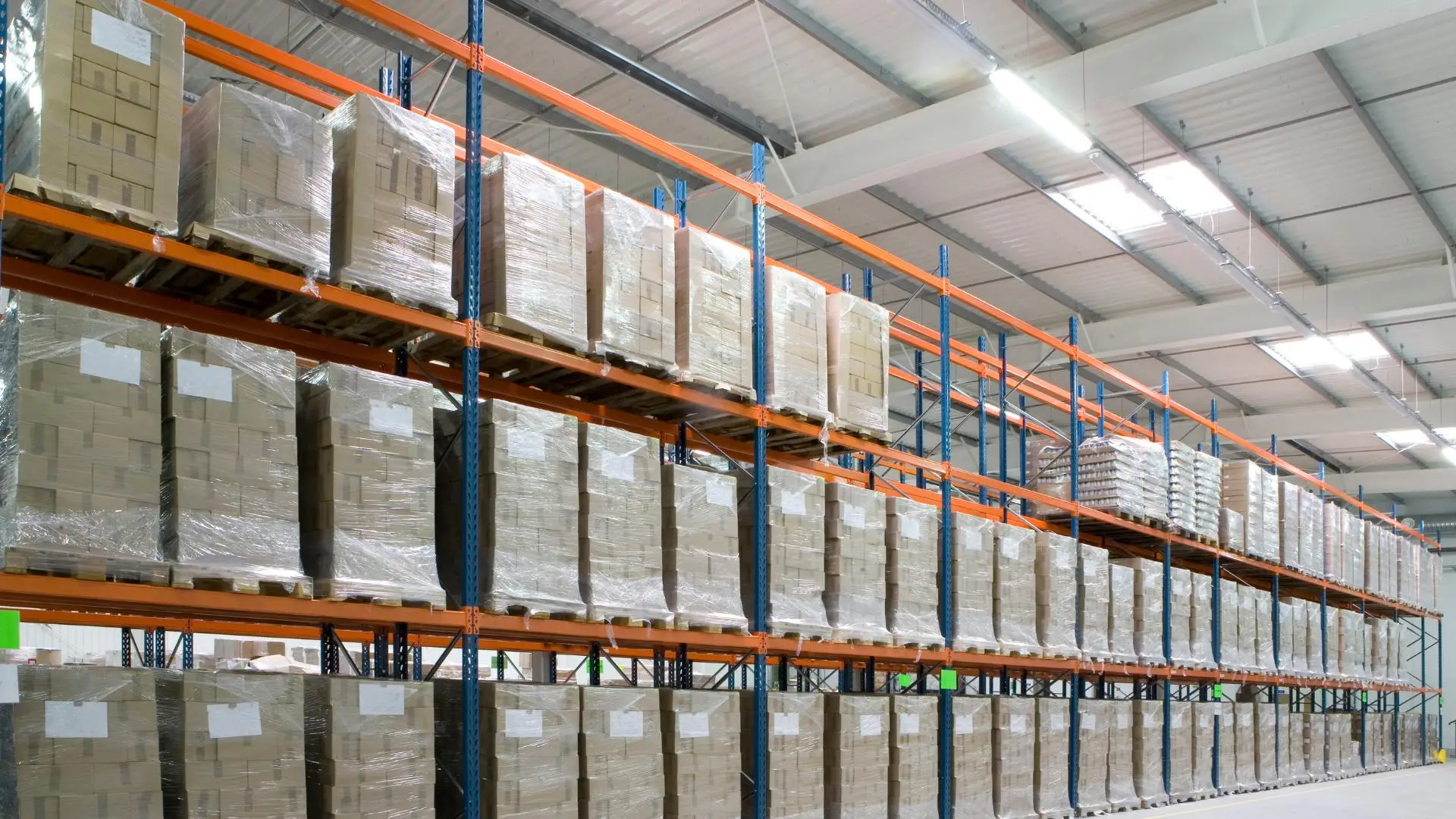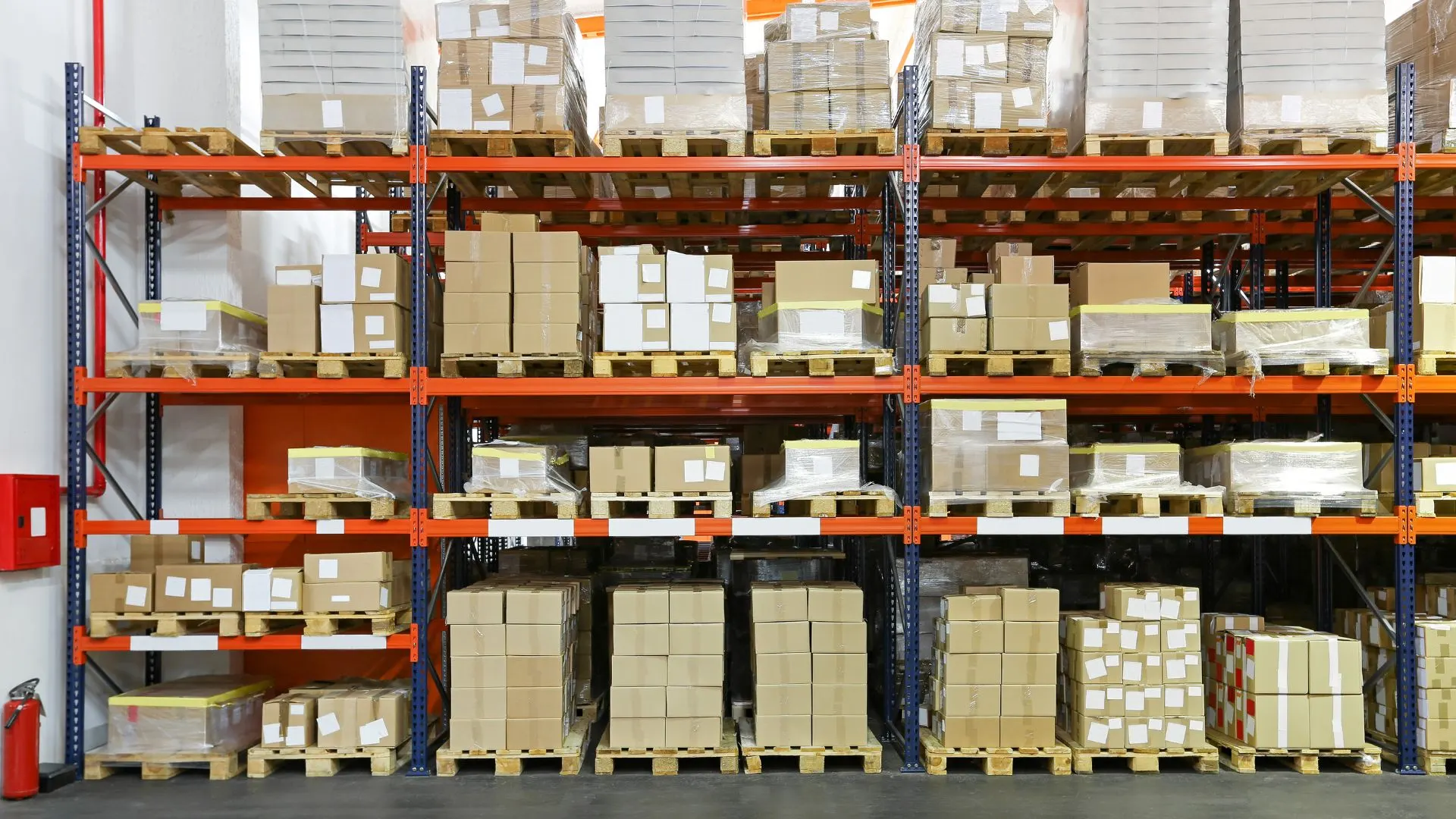
Warehouse pallet racking is a structural storage system designed to hold palletised goods safely and efficiently in commercial warehouses. For businesses in Australia, selecting the right pallet storage systems is a key part of strategic warehouse planning and can make a major difference in space utilisation, operational efficiency, and worker safety. Modern distribution, logistics and manufacturing operators rely heavily on optimized warehouse storage solutions to manage inventory flows while reducing labour costs and turnaround times. This guide breaks down the types of racking, how to assess load capacities, compliance with Australian safety standards, and how to plan an efficient layout for your facility.
What Is Warehouse Pallet Racking?
Warehouse pallet racking is a storage structure that holds pallets of goods at multiple levels using upright frames and horizontal beams. Instead of stacking pallets on the floor, racking systems organise them vertically, which maximises cubic storage in facilities.
A typical pallet racking system includes:
- Uprights (vertical frames) that support height,
- Beams that span between frames to carry pallets,
- Decking or pallet supports that stabilise loads,
- Safety components like rack guards, netting or backstops where needed.
SafeWork NSW notes that any racking should be designed around the size, shape and weight of products and compatible with handling equipment such as forklifts.
Pallet racking helps warehouses use vertical space rather than just floor space. Higher racks mean more storage within the same building footprint. Well‑designed racking also improves organisation, reduces travel time for handling equipment, and accelerates picking and replenishment.
Understanding Pallet Storage System Types
Static Pallet Storage Systems
Static systems are traditional racking solutions where pallets are placed and removed in fixed locations. They are simple, robust, and allow every pallet to be accessed individually. This makes them ideal for diverse SKUs and variable inventory levels.
Dynamic Pallet Storage Systems
Dynamic systems like roll‑through pallet racks use gravity or conveyors to move pallets from the loading end to the picking end. These are high‑throughput solutions for products that move fast, such as food and beverage or high-volume retail lines.
Automated Pallet Storage Systems
Automation takes pallet storage a step further with robotics, AS/RS units, and software managing where goods are stored and retrieved. These are becoming more common in high‑velocity distribution centres and larger e‑commerce warehouses.
This taxonomy highlights that different pallet storage systems suit different workflows, storage density needs, and operational priorities.
Types of Warehouse Pallet Racking Systems
Australian warehouses rely on various warehouse pallet racking systems to optimise storage density, accessibility, and workflow efficiency. Choosing the right type depends on inventory, floor space, and forklift compatibility. Below are the main types with their features and typical use cases.
Selective Pallet Racks
Selective pallet racks are the most common warehouse shelving solution for palletised goods. They allow direct access to each pallet, making them flexible for warehouses with mixed SKUs and frequent picking. Selective racks prioritise access over maximum density and are compatible with standard forklifts. In Australia, they follow AS 4084 standards with visible load signage for beams and uprights.
Key features:
- Direct pallet access
- Easy installation
- Flexible for different SKU sizes
- Suitable for general storage and e-commerce
Double‑Deep Pallet Racks
Double‑deep pallet racks increase storage density by allowing two pallets to be stored back‑to‑back on the same beam row. This cuts down aisle space but requires special reach trucks or equipment to access pallets at the rear. Double‑deep systems reduce travel time for forklifts compared to single‑deep layouts but sacrifice some direct access
Benefits:
- Higher storage density than selective racks
- Reduced forklift travel
- Efficient use of warehouse space
- Suitable for medium-volume operations
Drive‑In and Drive‑Through Racking
Drive‑in and drive‑through racking maximise storage by allowing forklifts to enter the rack structure. Drive-in uses Last-In, First-Out (LIFO) inventory management, while drive-through can support First-In, First-Out (FIFO) if both ends are open. These systems are best for large, homogeneous batches where high-density storage is needed.
Advantages:
- High cube utilisation
- Good for seasonal or bulk stock
- Efficient for uniform palletised goods
- Reduces floor space needed
Roll‑Through (Pallet Flow) Racks
Roll-through pallet racks, also called pallet flow racks, use gravity-fed rollers to move pallets from the loading to the picking side. Ideal for FIFO workflows, these racks reduce forklift travel and improve picking efficiency. They are widely used for FMCG, grocery, and beverage distribution.
Key points:
- FIFO inventory rotation
- High throughput
- Reduces forklift congestion
- Supports fast-moving SKUs
Push‑Back Racking
Push-back racking stores pallets on nested carts that slide on rails. When a new pallet is loaded, it pushes the existing pallets back. This system operates on LIFO principles and provides higher density than selective racks while maintaining easy front access.
Benefits:
- Higher density than selective racks
- Easy loading and unloading from the front
- Efficient for moderate SKU warehouses
- Reduces aisle space requirements
Narrow Aisle Racking
Narrow aisle racking reduces aisle width and increases storage density. Specialised forklifts, such as reach or turret trucks, are needed to navigate tight spaces. This strategy works well with selective or double-deep racks when space is limited, but access is still important.
Highlights:
- Increases storage per square metre
- Requires specialised equipment
- Maintains good access and picking efficiency
- Suitable for medium to high-density warehouses
Very Narrow Aisle Systems
VNA systems are an extension of narrow aisles, using even tighter aisles with turret trucks for maximum storage density. They are ideal for high-rent or space-constrained warehouses and require trained operators.
Key points:
- Extremely high density
- Requires specialised forklifts and operators
- Best for slow-moving or high-value stock
- Reduces floor space for aisles
Multi‑Tier Racking
Multi-tier racking adds mezzanine levels to a warehouse, allowing vertical storage above ground level. It is suitable for cartons, small parts, or automated picking systems above pallet areas. Planning is required to ensure structural safety and proper access.
Advantages:
- Maximises vertical space
- Supports picking zones and automated storage
- Integrates with lifts or conveyors
- Reduces overall footprint
Cantilever Racking
Cantilever racking supports long or irregular items, such as timber, pipes, or sheet goods. It has no front posts, making it suitable for non-palletised long inventory. While not a standard pallet rack, it is essential for warehouses handling specialised bulky items.
Key features:
- Supports long or irregular loads
- Flexible arm configurations
- Ideal for construction materials or pipes
- Complements pallet storage systems
Mobile Racking Systems
Mobile racking systems mount racks on movable bases that slide on rails. Aisles open only when needed, maximising storage density. They are ideal for high-value or slow-moving stock and require careful installation and planning.
Benefits:
- Adjustable aisles
- Maximum storage utilisation
- Suitable for security-sensitive inventory
- Reduces unused aisle space
Understanding Pallet Rack Load Capacity
What Determines Load Capacity?
Load capacity is the maximum weight a rack can hold and depends on beam span, beam profile, upright frame strength, bracing, and load distribution. Uprights and beams are engineered to specific structural tolerances under Australian Standards (AS 4084). For a detailed breakdown of how these ratings work in practice, the pallet rack weight capacity guide covers the key calculations and compliance requirements.
Beam Load Capacity
Each pair of beams is given a rated load based on engineering calculations. This number must be visible on load signage as part of compliance requirements.
Frame Load Capacity
The upright frame’s ability to carry vertical load limits how many beam levels and what weights each rack can support.
Total Rack System Capacity
Total capacity considers all beams, frames, and configurations. It’s not simply the sum of individual pallet capacities.
Common Load Capacity Ranges
Australian warehouses typically see:
- Light duty: 500–1,000 kg per level
- Medium duty: 1,000–2,000 kg
- Heavy duty: 2,000–4,000 kg+ per level
Actual limits come from engineering design and testing to AS 4084 standards. For operations requiring heavy-duty structural performance, galvanised racking systems offer additional corrosion resistance alongside high load ratings.
Safety Standards and Compliance
Under Australian WHS laws, racking must be designed and maintained safely. Regulators reference AS 4084: Steel Storage Racking, which sets out requirements for design, installation, load signage, and maintenance.
Benefits of Installing Warehouse Pallet Racking Systems
Maximising Vertical Space
Racking lets warehouses use every cubic metre of space, reducing land costs.
Faster Inventory Access
Well‑organised pallet storage systems cut down forklift travel time and speed up order fulfilment.
Improved Warehouse Safety
Properly engineered and compliant racking reduces the risk of collapses or pallet falls when compared to ad hoc stacking.
Better Inventory Management
Racking supports logical location codes and storage strategies that tie directly into inventory software.
Scalability for Warehouse Growth
Modular racking can be extended as needs grow, allowing incremental investment.
How to Choose the Right Pallet Racking System
Assess Your Inventory Type
Consider pallet sizes, weights, and turnover patterns. High‑mix, low‑volume SKUs often do better with selective pallet racks, while homogenous batches benefit from high‑density systems. Different pallet racking types can help narrow down the right fit for your inventory profile.
Evaluate Warehouse Layout and Floor Space
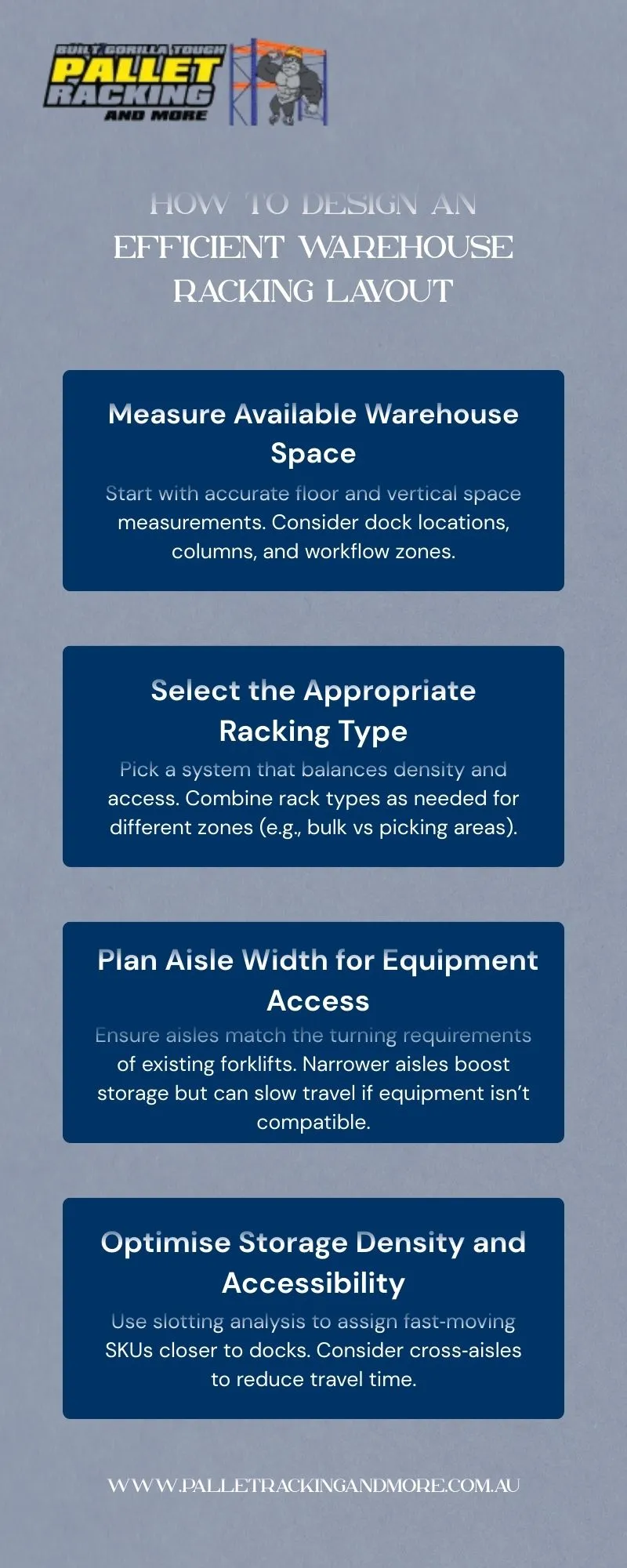
Measure clear heights, column spacing, and floor load limits. Ensure aisles are wide enough for forklifts and material handling equipment. WorkSafe Victoria’s guidance notes that the racking layout should be compatible with the material handling equipment used in the workplace, with aisle width matching the turning circle of the forklift used for picking and replenishment.
Consider Picking Frequency and Workflow
High‑velocity workflows may benefit from flow racks or narrow aisle layouts, while slower, varied picking can use selective racks.
Material Handling Equipment Compatibility
Match the rack layout to fork truck turning radius and reach capacities. Tight aisles maximise storage but require specialised equipment.
Pallet Weight and Dimensions
Heavier pallets need stronger beams and uprights with clear signage per AS 4084 guidance. Industrial pallet racks are engineered for heavier applications and are worth considering when loads consistently push into higher weight ranges..
Future Scalability
Anticipate growth and SKU changes. Choose systems that can be reconfigured or expanded without costly replacements. Warehouses planning significant changes should also review what a pallet racking upgrade involves before committing to a layout.
How to Design an Efficient Warehouse Racking Layout
Warehouse Pallet Racking Safety & Australian Compliance Standards
Australian Warehouse Safety Guidelines
Work health and safety (WHS) laws require that pallet racking and storage be without risks to health and safety and maintained per industry standards. Safety regulators provide guidance on layout, rated capacity signage, and inspection practices. The pallet racking safety guidelines outline the key obligations for businesses operating under WHS legislation.
Structural Design Standards
The Australian Standard AS 4084: Steel Storage Racking sets technical requirements for racking design, load ratings, signage, and installation. Load signs must show unit load, beam load, and bay load levels.
Rack Inspections and Maintenance Schedule
Racking should be inspected regularly for damage, deformation, and overload, with frequent internal checks and formal documented inspections by competent persons at least annually.
Load Labeling Requirements
Regulators advise that safe working load limits are visibly marked on every rack level and bay so operators can verify loads when storing pallets. SafeWork SA recommends displaying safety signs at the end of every rack showing the safe working load and maximum shelf capacity.
Preventing Overloading and Structural Damage
Never exceed rated loads. Overloading or altering racking without engineering review increases the risk of failure and regulatory non‑compliance.
Future Trends in Warehouse Storage Solutions
Smart Warehousing and Automation
Warehouses are increasingly integrating software with pallet storage systems for real‑time location tracking and automated replenishment.
AI‑Driven Inventory Management Systems
Machine learning helps forecast stock movement, suggest optimal storage locations and reduce travel distances.
Automated Storage and Retrieval Systems (AS/RS)
Robotic AS/RS solutions boost throughput and reduce labour needs in high‑volume warehouses.
High‑Density and Robotics‑Integrated Storage
Robots working with dense storage improve footprint utilisation while maintaining accessibility.
Conclusion
Choosing the right warehouse pallet racking system is essential for maximising storage, efficiency, and safety in Australian warehouses. Each type, including selective, double deep, drive in, roll through, heavy duty, narrow aisle, multi-tier, cantilever, or mobile racking, offers different advantages based on inventory, space, and equipment. Using a combination of systems improves workflow and storage density, while understanding pallet rack load capacity ensures safe and effective warehouse operations.
FAQs
How much weight can pallet racking hold?
Load capacity varies by design and rating. Australian systems are engineered with safe loads clearly marked on signage per AS 4084 requirements. Typical pallet positions can range from several hundred kilograms to multiple tonnes based on components.
How do I calculate pallet rack load capacity?
Calculate load capacity by confirming the manufacturer or engineer’s ratings for unit load, beam level and bay total load, ensuring your pallet weights and patterns fall within those limits.
How often should pallet racking be inspected?
Racking should have routine visual checks and formal inspections by a competent person at least every 12 months under WHS guidance.
How much aisle space should be between pallet racks?
Aisle space should match the turning circle and operating envelope of your forklifts and material handling equipment. Planning this properly avoids operational bottlenecks.