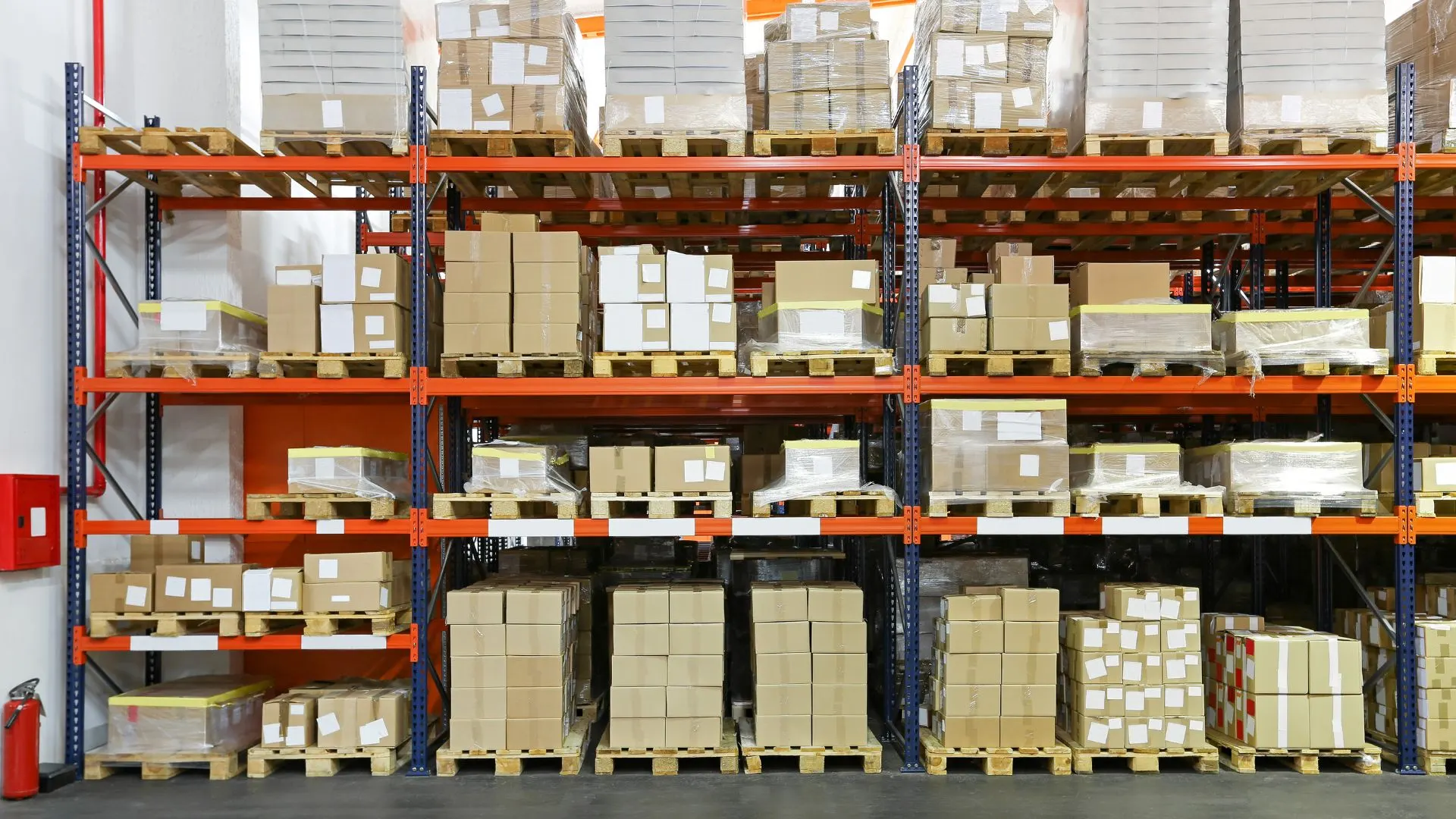
Pallet racking systems support thousands of kilograms of inventory in warehouses across Australia, yet inadequate maintenance and inspection practices continue to cause preventable accidents. Safe Work Australia identifies storage system failures as a recurring cause of warehouse injuries, often linked to structural damage, overloading, and missed inspections.”
This guide brings together requirements from AS 4084:2021 (the Australian Standard for Steel Storage Racking), guidance from state WorkSafe organisations, and recognised industry practices to help warehouse managers build effective and compliant racking safety programs.
Understanding Pallet Racking Safety Requirements
Pallet racking safety encompasses the design, installation, use, inspection, and maintenance of warehouse storage systems. According to Standards Australia’s AS 4084:2021, every racking system must be designed by a qualified engineer, installed correctly, maintained regularly, and inspected according to documented schedules.
Core Safety Components
Effective pallet racking safety is not achieved through a single control. It depends on several interconnected elements working together:
Structural integrity: All components, uprights, beams, bracing, base plates, and anchors must remain undamaged and capable of supporting intended loads. Research indicates that even minor damage from forklift impacts can compromise structural capacity by 30-50%.
Load capacity compliance: Every rack level has a maximum safe working load determined by engineering calculations. Exceeding these limits places excessive stress on beams and uprights, creating a failure risk.
Regular inspection: AS 4084:2021 requires annual inspections by competent persons, with additional monthly visual checks recommended for high-traffic facilities.
Maintenance and repair: Damaged components require prompt assessment and repair by qualified technicians. Temporary fixes or deferred maintenance can substantially increase risk.
Why Pallet Racking Safety Matters
Understanding the consequences of racking failures helps warehouse managers prioritise safety investments.
Legal and Financial Impact
Australian workplace health and safety legislation imposes specific obligations on warehouse operators. According to WorkSafe Victoria, businesses must eliminate or minimise risks “so far as is reasonably practicable.” For racking systems, this translates to maintaining systems in a safe working condition, conducting regular inspections, and promptly repairing damaged components.
SafeWork NSW and equivalent state regulators conduct workplace audits and can issue improvement notices, prohibition orders, or prosecutions for non-compliance. Enforcement actions typically involve fines ranging from $5,000 to $50,000 for individual violations, with potential penalties up to $500,000 for serious corporate offences.
Beyond regulatory penalties, racking failures create operational costs, including product damage, downtime during repairs, increased insurance premiums, and reputational damage. Guidance from warehouse safety consultants and regulatory bodies indicates that comprehensive inspection and maintenance programs for medium-sized facilities commonly fall within the $3,000–$8,000 annual range.
Inspection Requirements and Best Practices
AS 4084:2021 establishes specific inspection requirements for all storage racking in Australia.
Annual Professional Inspections
The standard mandates annual inspections by a “competent person”, someone with adequate training, qualifications, and experience to identify racking hazards. According to AS 4084:2021 Section 12, these inspections must examine all structural components systematically, document findings in written reports, and recommend corrective actions with priority levels.
Professional inspection services in Australia typically cost $500-$1,500, depending on facility size, rack quantity, and system complexity.
Monthly and Daily Inspections
Annual inspections establish baseline compliance, but they are not sufficient on their own in active warehouse environments. While annual professional inspections satisfy minimum legal requirements, industry best practice recommends monthly internal visual checks conducted by trained warehouse staff. These inspections identify new damage between professional visits, allowing prompt response before minor issues escalate.
Forklift operators and warehouse staff should conduct daily visual observations during normal operations. Simple reporting systems, such as hazard report forms or mobile apps, encourage workers to communicate safety concerns without delay.
Common Damage Types
During inspections, certain damage patterns appear repeatedly across different warehouse types:
- Upright damage: Bends, dents, or twists in vertical columns from forklift impacts
- Beam damage: Cracks in beam connections, sagging under load, or visible deflection
- Connection failures: Missing or damaged safety clips or locking mechanisms
- Base plate issues: Loose or missing floor anchors, indicating movement
- Corrosion: Rust or material deterioration affecting structural integrity
Inspection reports and guidance published by racking manufacturers, safety inspectors, and WorkSafe bodies consistently identify forklift impacts, bent uprights, and missing safety clips as common issues in warehouse racking systems.
Safety Audits and Assessments
Safety audits differ from inspections by focusing on safety management systems, procedures, and documentation rather than just physical conditions.
What Safety Audits Include
According to guidance from Safe Work Australia, effective racking safety audits examine:
- Documentation systems (inspection records, maintenance logs, incident reports)
- Procedures and policies for loading, inspection, and damage reporting
- Training records showing workers receive appropriate safety instruction
- Load capacity, signage, visibility, and accuracy
- Compliance status with AS 4084:2021 and state WorkSafe regulations
Facilities conducting annual or biannual safety audits report improved hazard identification, enhanced accountability, and better compliance posture. Professional assessments generate detailed reports identifying both immediate hazards and longer-term improvement opportunities, typically costing $2,000-$8,000 depending on facility complexity.
Load Capacity and Signage Requirements
According to AS 4084:2021, every racking installation requires load capacity signage clearly stating maximum beam load, maximum bay load, and maximum floor load. These ratings come from engineering calculations accounting for component strength, rack configuration, load distribution patterns, and safety factors.
Load capacity plates must be installed at the end of each rack run, positioned for easy visibility by forklift operators and warehouse staff.
Common Capacity Violations
Warehouse safety audits identify several frequent capacity-related issues:
- Informal load increases without engineering review
- Missing or damaged signage
- Concentrated loads in single locations
- Stacking materials higher than design specifications
According to structural engineering analysis, even modest overloading (10-15% above rated capacity) can reduce rack safety margins to dangerous levels.
Forklift Impacts and Protection Strategies
Forklift contact represents the leading cause of racking damage in Australian warehouses. When forklifts strike rack uprights, the impact transfers significant force into structural members designed primarily to support vertical loads.
Protection Methods
AS 4084:2021 doesn’t mandate impact protection, but professional practice strongly recommends it for high-traffic facilities. Common protection methods include:
Column guards: Heavy-duty steel barriers installed around upright bases, absorbing and deflecting forklift impacts. Quality guards cost $150-$400 per upright but can prevent damage, costing thousands in repairs and downtime.
End-of-aisle protection: Bollards or guard rails at rack row ends where impacts frequently occur.
Floor marking: Clear lane delineation helps operators maintain safe distances from racking.
Case studies and guidance from safety equipment manufacturers indicate that installing column guards and aisle protection can substantially reduce the frequency and severity of racking damage.
Staff Training Requirements
According to Safe Work Australia guidance, warehouse staff working near or with racking systems should receive instruction covering:
- Loading principles and proper pallet placement
- Capacity awareness and reading load signage
- Damage recognition and reporting procedures
- Forklift safety and impact prevention
- Emergency response procedures
Training effectiveness improves when programs include visual examples of damage types, hands-on inspection practice, regular refresher sessions (annually, minimum), and competency assessments confirming understanding.
Damage Response and Repair Procedures
When inspections identify damage, AS 4084:2021 provides specific guidance using a traffic-light severity system:
Green (Minor): Cosmetic issues not affecting structural integrity. Monitoring is recommended, but immediate repair is not critical.
Amber (Significant): Structural damage reduces load capacity but does not create immediate danger. Requires load reduction and repair scheduling within 2-4 weeks.
Red (Severe): Immediate hazard requiring urgent action. Affected bays must be unloaded and isolated immediately, with repairs completed before they are returned to service.
Repair Standards
According to AS 4084:2021, repairs must be performed by competent persons, restore original design strength, follow manufacturer specifications, and be documented with details of work performed. Replacing damaged components is preferred over repair in most cases. Welding or modification requires engineering approval.
Warehouses must maintain records of all damage incidents, assessment findings, repair work performed, and engineering evaluations demonstrating due diligence during regulatory audits.
Implementation Checklist
Based on professional guidelines from industry associations and regulatory bodies, successful racking safety implementation includes:
Assessment Phase:
- Document all product weights, dimensions, and storage requirements
- Review AS 4084:2021 requirements and state WorkSafe regulations
- Determine current inspection status and compliance gaps
Ongoing Operations:
- Schedule annual professional inspections ($500-1,500)
- Establish monthly internal visual inspection procedures
- Train all forklift operators and warehouse staff
- Install load capacity signage at all rack locations
- Implement a damage reporting system
- Maintain documentation for a minimum of 7 years
Maintenance Program:
- Respond immediately to red-level (severe) damage
- Schedule amber-level repairs within 2-4 weeks
- Consider column protection installation in high-traffic areas
- Budget $3,000-8,000 annually for a comprehensive safety program
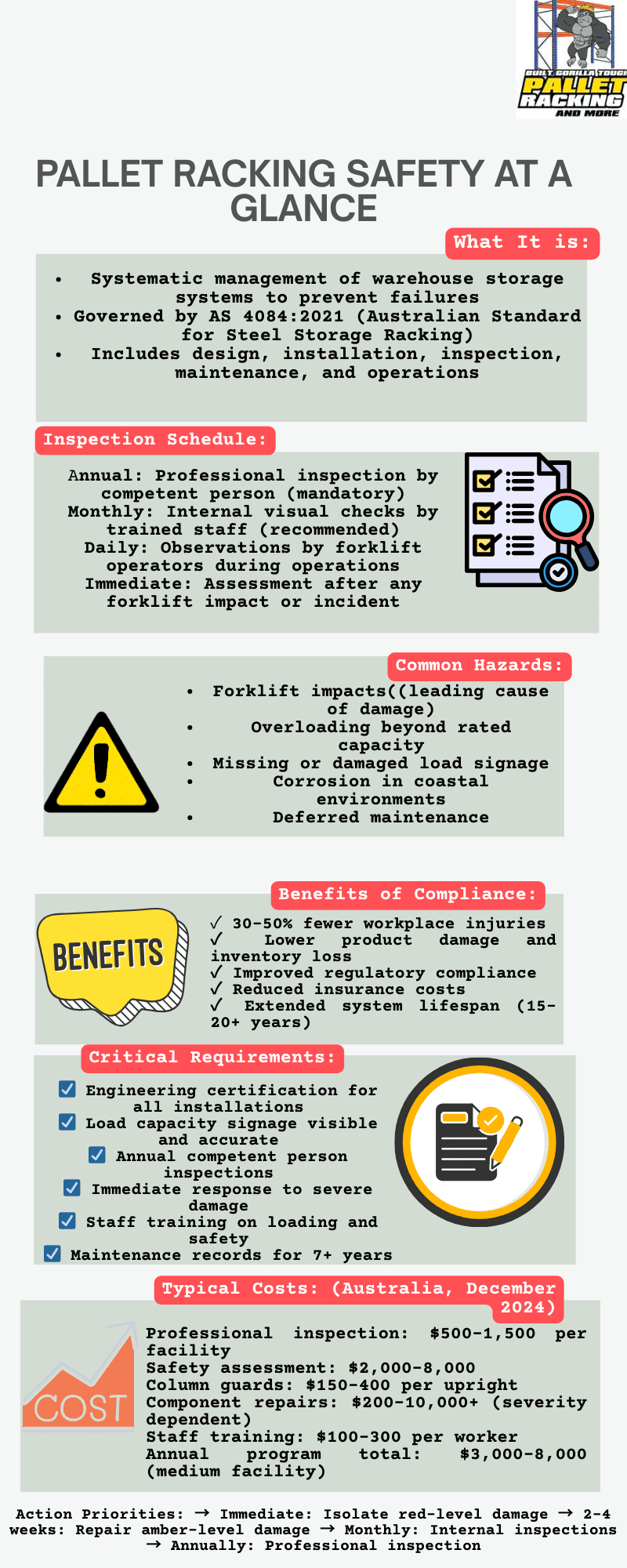
PALLET RACKING SAFETY AT A GLANCE
Conclusion
Pallet racking safety protects warehouse workers, preserves inventory, and ensures regulatory compliance across Australian operations. Systematic implementation of AS 4084:2021 requirements, including annual professional inspections, regular internal monitoring, prompt damage response, and comprehensive staff training, creates sustainable safety programs that prevent incidents.
The investment required for reliable racking safety (typically $3,000-$8,000 annually for medium-sized facilities) represents a small fraction of the costs associated with structural failures, regulatory violations, or workplace injuries. Warehouses prioritising proactive safety management achieve better operational outcomes while protecting their most valuable asset, their people.
Transparency Statement: This guide synthesises information from AS 4084:2021, Safe Work Australia warehouse safety resources, and state WorkSafe organisation guidance. Content is educational guidance for warehouse managers. Specific requirements should be determined by qualified engineers and racking safety specialists based on individual facility conditions and current regulatory obligations.
Read More:
Shelving Solutions for Homes, Offices, and Warehouses
Drive-In Pallet Racking Guide For High-Density Storage
FAQS
Q: What does AS 4084:2021 require for pallet racking safety in Australia?
AS 4084:2021 mandates engineering certification for all racks, clear load capacity signage, annual inspections by competent persons, and timely repairs of damaged elements. It uses a traffic-light system: green (minor), amber (significant), red (severe). Compliance is mandatory under state WorkSafe regulations.
Q: How often should warehouse racking be inspected?
Professional inspections are required annually, with monthly internal checks by trained staff and daily visual checks by operators. High-traffic or previously damaged facilities may need more frequent inspections.
Q: What should I do after a forklift impacts warehouse racking?
Stop operations in the affected area, assess for deformation or damage, and isolate the bay if necessary. Minor impacts can reduce structural capacity significantly. Contact a qualified inspector, follow the traffic-light classification, and document the incident. Column guards can help prevent damage.
Q: What are the penalties for non-compliant racking, and how are violations discovered?
WorkSafe inspections and investigations enforce compliance. Penalties include fines from $5,000 to $500,000, improvement notices, or prohibition orders. Common issues are missing certifications, inadequate inspections, and absent load signage. Violations are often identified during routine checks, incidents, or complaints.